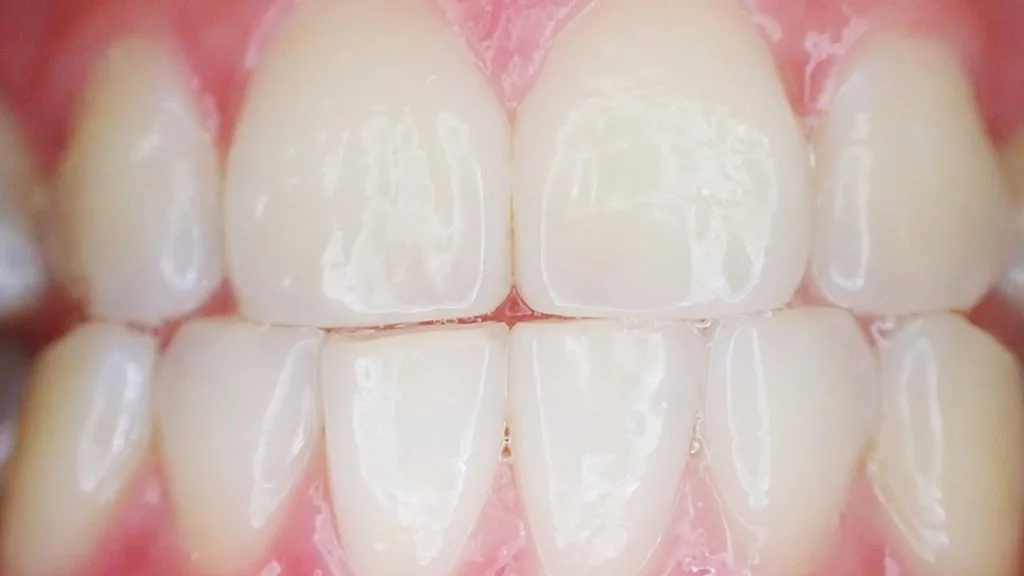
Teeth whitening carried out under a dentist's supervision with gels of a suitable concentration is considered safe for healthy teeth. It does not wear away enamel or make teeth thinner. The most common side effect is temporary sensitivity lasting a few days after treatment. Whitening is not permanent. Depending on diet and habits, the colour usually darkens gradually over 1-3 years.
How Does Teeth Whitening Work?
Professional whitening uses gels containing hydrogen peroxide or carbamide peroxide. These break down the colour-causing molecules inside the enamel and lighten the tooth. No layer is scraped or sanded off the surface of the tooth. Applied correctly, whitening therefore causes no permanent damage to enamel.
In-clinic whitening applies a higher-concentration gel for a short time, after the gums are first covered with a protective barrier. At-home whitening uses a lower-concentration gel in custom trays made by your dentist, worn over several days or weeks. Some methods use a light or laser, but it is still the gel that does the whitening.
When Can Whitening Cause Harm?
- Products used without a dentist's supervision: High-concentration gels bought online can irritate the gums, and trays that do not fit can give uneven results. Abrasive whitening powders and charcoal toothpastes do not whiten teeth; they scrub stains off by wearing the surface. Used for a long time they can thin the enamel.
- Untreated decay and leaking fillings: The gel can reach the inside of the tooth through decay and cause pain. These problems are treated before whitening.
- Gum disease and exposed roots: Sensitivity can increase considerably.
Is There Sensitivity, and Does It Hurt?
No pain is expected during the procedure. Some people feel brief, sharp twinges in their teeth. For 1-3 days afterwards the teeth may be sensitive to cold and heat. This usually passes on its own. Toothpastes for sensitive teeth and fluoride applications help. If you already have sensitive teeth, tell your dentist; the session length or gel concentration can be adjusted.
Is Whitening Permanent?
The result is not permanent, but it can last a long time. Coffee, tea, cola, red wine and smoking bring the colour back faster. For many people the result remains satisfying for 1-3 years, and a short top-up treatment can be done when needed.
For the first 48 hours after whitening, teeth pick up stains more easily. During this time it is advisable to avoid coffee, tea, dark drinks and sauces, and smoking.
Who Should Not Have Whitening, or Should Postpone It?
- Pregnant and breastfeeding women (postponed as a precaution),
- Young children whose teeth have not finished developing,
- People with untreated decay or gum disease (treated first),
- People allergic to peroxide.
Whitening does not change the colour of fillings, crowns or veneers. People with fillings or crowns on their front teeth may notice a colour mismatch after whitening, and these restorations may need to be replaced. Some discolouration caused by medication or tooth development responds poorly to whitening. In these cases, options such as veneers can be discussed.
Frequently Asked Questions
How many sessions does teeth whitening take?
In-clinic whitening is often completed in a single session of about one hour; sometimes a second session is needed. At-home whitening usually takes 1-2 weeks.
Is scaling needed before whitening?
It is usually recommended. Once tartar and surface stains are removed, the gel contacts the teeth evenly and the result is more uniform. Sometimes cleaning alone makes the teeth noticeably lighter.
Whitening or crowns?
If your teeth are healthy and the only problem is colour, whitening is considered first because it lightens teeth without altering them. Veneers or crowns are considered for shape problems, fractures, large fillings or discolouration that does not respond to whitening.
Whether your teeth are suitable for whitening can be assessed at an examination. For more information see our teeth whitening page. To book an examination at our clinic in Güvenevler, Çankaya, call +90 540 640 6006.
This article is for general information only. Diagnosis and treatment decisions are made by your dentist after an examination.