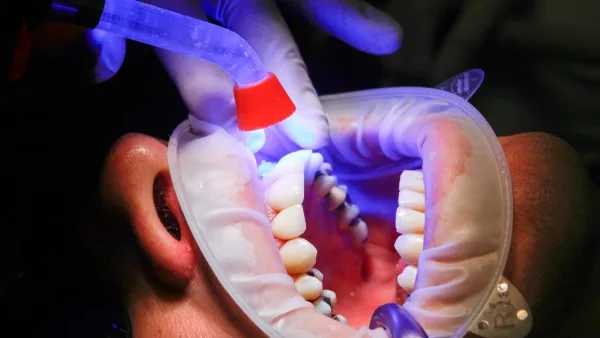
A dental filling is usually a painless procedure. Small, shallow cavities may not even need numbing. For deep cavities the area is numbed with local anaesthesia, and during the procedure you feel only vibration and pressure. A small filling usually takes 20-40 minutes. Today's most commonly used tooth-coloured composite fillings harden immediately with a curing light, so you can eat once the numbness has worn off.
How Is a Filling Done?
- The cavity is identified by examination and, if needed, an X-ray.
- The area is numbed if necessary.
- The decayed tissue is removed and healthy tissue is preserved.
- The tooth surface is prepared. The composite filling is placed layer by layer and each layer is hardened with a light.
- The bite is checked, and the filling is shaped and polished.
Does It Hurt?
If the area is numbed, no pain is felt during the procedure. For people who are nervous about the injection, a numbing gel can be applied to the surface first. If the decay is very close to the nerve, the tooth may be sensitive to cold for a few days afterwards. This sensitivity is expected to ease over the following days.
What to Pay Attention to After a Filling
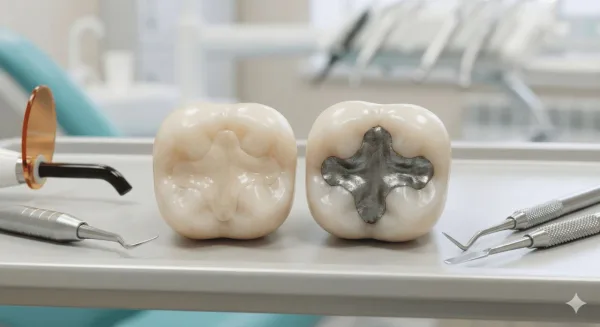
- Eating: A composite filling hardens immediately. But do not eat until the numbness wears off (about 2-3 hours), as you could bite your cheek or tongue without noticing. With older silver (amalgam) fillings, avoiding hard food on that side for 24 hours is recommended.
- A high filling: If, once the numbness has gone, the filled tooth touches first when you close your teeth, or biting hurts, the filling may be slightly high. It is corrected with a quick check.
- Sensitivity: A few days of sensitivity to cold is normal. Pain that starts on its own, throbs or wakes you at night may mean the nerve is affected. In that case see your dentist. With deep decay, root canal treatment may be needed later.
Are Fillings Harmful?
Today most fillings are made with tooth-coloured composite materials. Because older silver (amalgam) fillings contain mercury, their use has been reduced in many countries; in the European Union, from 1 January 2025, amalgam is no longer used except where the dentist considers it strictly necessary. However, removing an intact old amalgam filling for this reason alone is generally not recommended, because removal also costs healthy tooth structure. The U.S. Food and Drug Administration (FDA) likewise notes that removal temporarily increases exposure to mercury vapour and recommends that intact amalgam fillings should not be removed unless medically necessary. Fillings that are broken, decayed or leaking are replaced. We explain the differences between filling types in our filling treatment article.
How Can Decay Be Spotted Early?
Early decay usually causes no pain. Brief twinges with sweet or cold things, brown or black spots on a tooth, a cavity where food gets stuck, or floss catching and shredding at one point can be signs of decay. Decay between the teeth is often visible only on X-rays. Check-ups at least every six months allow decay to be caught while it is small and before root canal treatment is needed; for people at high risk of decay, the interval can be shortened.
Frequently Asked Questions
How long does a filling last?
How long a filling lasts depends on its size, the position of the tooth, oral hygiene and habits such as clenching. With good care, composite fillings can last for many years. If discolouration, cracks or new decay appear at the edges, they are replaced. A Cochrane review reports that composite fillings in back teeth may need replacing more often than amalgam fillings, while stressing that composite materials have improved considerably in recent years.
Why is my tooth sensitive after a filling?
After a filling for deep decay, sensitivity to cold in the following days is normal and fades. Pain when biting is usually caused by the filling being slightly high. If pain does not go away or gets worse, have it checked.
Can fillings be done during pregnancy?
Yes. Necessary fillings can be done during pregnancy, preferably in the second trimester. Always tell your dentist that you are pregnant.
Whether you have decay can be determined with an examination and, if needed, an X-ray. For more information see our decay and fillings page, and for fees in the TDB tariff our filling fees article. To book an examination at our clinic in Güvenevler, Çankaya, call +90 540 640 6006.
This article is for general information only. Diagnosis and treatment decisions are made by your dentist after an examination.
Sources this article is based on
The information in this article is based on the sources below. You can read all of them free of charge via the links; under each one we summarise what it says.
- Direct composite resin fillings versus amalgam fillings for permanent posterior teeth
Worthington HV, Khangura S, Seal K, et al. Cochrane Database of Systematic Reviews 2021;8:CD005620 · doi:10.1002/14651858.CD005620.pub3
What it says: Cochrane review comparing composite and amalgam fillings in back teeth: composite fillings had higher rates of failure and of new decay at the margins (low-certainty evidence), with no clinically important difference in safety. It notes that composite materials have improved since the trials were done.
- FDA Issues Recommendations for Certain High-Risk Groups Regarding Mercury-Containing Dental Amalgam
U.S. Food and Drug Administration (FDA). fda.gov 24 September 2020
What it says: U.S. FDA: mercury-free filling materials are recommended instead of amalgam for high-risk groups such as pregnant and nursing women, children under six and people with kidney or neurological disease; intact amalgam fillings should not be removed unless medically necessary.
- Regulation (EU) 2024/1849 amending Regulation (EU) 2017/852 as regards dental amalgam and other mercury-added products subject to manufacturing, import and export restrictions
European Parliament and Council of the European Union. eur-lex.europa.eu 13 June 2024
What it says: EU regulation: from 1 January 2025, dental amalgam is no longer used in dental treatment except where the dentist considers it strictly necessary because of the patient's specific medical needs.
- Oral Health Care During Pregnancy and Through the Lifespan. Committee Opinion No. 569
American College of Obstetricians and Gynecologists (ACOG). acog.org
What it says: American College of Obstetricians and Gynecologists: dental examination and treatment are safe during pregnancy, and necessary treatment should not be postponed.