The smile may look healthy from the outside, yet some problems develop beneath the surface. An unexplained feeling of pressure in the jaw, pain spreading to the ear or recurring swelling of the gum may be signs of an impacted tooth. When wisdom teeth cannot find enough room in a narrow jaw, they can affect quality of life. Sometimes they remain completely within the bone; sometimes they are left partly erupted, which encourages infection.
"It doesn't hurt at the moment, do I need to have it out?" is a question we hear often. The absence of pain does not mean the tooth carries no risk. Over time, impacted teeth can press on neighbouring teeth and disturb the alignment. Bacteria that collect in places the toothbrush cannot reach can also cause decay in the healthy tooth next to them. In the long term they can even lead to cyst formation in the jaw bone.
Scientific sources also contain different views on this question. Most systematic reviews do not support the idea that wisdom teeth cause crowding of the front teeth. The UK national guidance (NICE) recommends that impacted wisdom teeth causing no problems should not be removed as a preventive measure. A Cochrane review, meanwhile, reports that there is not enough evidence to decide definitively between removing and keeping symptom-free impacted wisdom teeth, and that teeth left in place may increase the long-term risk of gum disease around the neighbouring second molar. The decision is therefore made together with the patient, based on the examination and imaging findings.
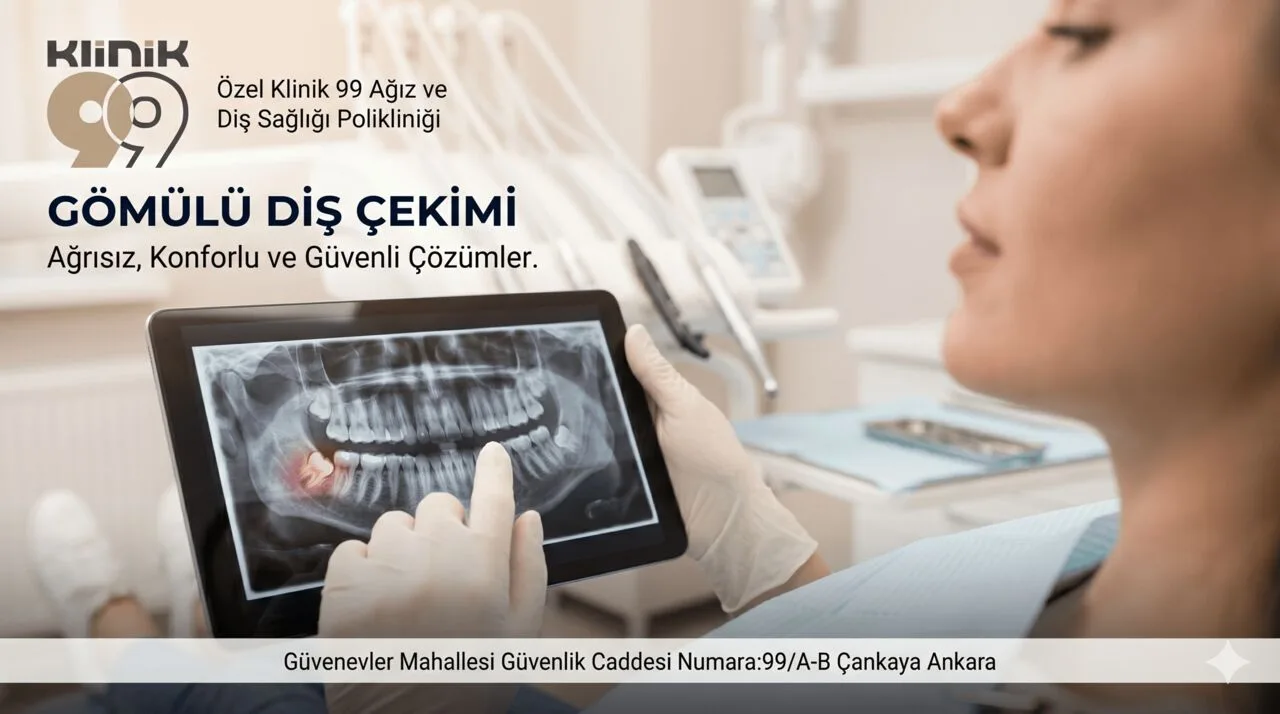
Do not let the word "extraction" scare you; those legendary, difficult operations that go from mouth to mouth are now a thing of the past. With our advanced imaging methods we clearly examine the position of the tooth, and we complete the procedure quite comfortably by numbing only that area. You can get through the slight sensitivity afterwards, with the right medication we recommend and an ice compress, without disrupting your daily life.
Rather than putting it off, it is advisable to have the situation assessed. At Klinik 99 Oral and Dental Health Polyclinic, impacted teeth are evaluated with a detailed examination and imaging. For fees, see our article on impacted tooth surgery prices.
Sources this article is based on
The information in this article is based on the sources below. You can read all of them free of charge via the links; under each one we summarise what it says.
- Guidance on the extraction of wisdom teeth (TA1)
NICE (UK National Institute for Health and Care Excellence). nice.org.uk last reviewed 31 March 2015
What it says: UK national guidance: prophylactic removal of pathology-free impacted wisdom teeth should be discontinued; removal should be limited to cases with evidence of disease, such as unrestorable decay, recurrent infection (pericoronitis), abscess, cysts or damage to the neighbouring tooth.
- Surgical removal versus retention for the management of asymptomatic disease-free impacted wisdom teeth
Ghaeminia H, Nienhuijs ME, Toedtling V, et al. Cochrane Database of Systematic Reviews 2020;5:CD003879 · doi:10.1002/14651858.CD003879.pub5
What it says: Cochrane review comparing removal and retention of symptom-free impacted wisdom teeth: there is not enough evidence to decide; retained teeth may increase the long-term risk of gum disease around the neighbouring second molar (very-low-certainty evidence). The decision should be shared with the patient.
- The role of mandibular third molars on lower anterior teeth crowding and relapse after orthodontic treatment: a systematic review
Zawawi KH, Melis M. The Scientific World Journal 2014;2014:615429 · doi:10.1155/2014/615429
What it says: Systematic review of the effect of wisdom teeth on crowding of the lower front teeth: most studies do not support a cause-and-effect relationship, so removing wisdom teeth to prevent crowding is not justified.