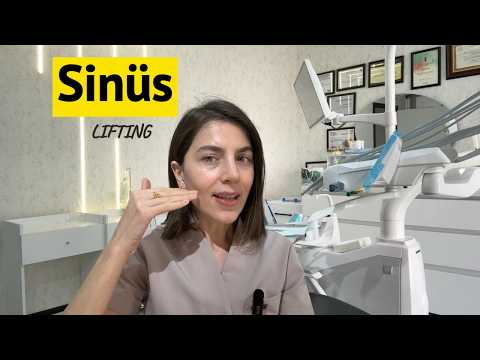
The most common problem encountered when an implant is to be placed in the back of the upper jaw is insufficient bone height. In this case, a bone augmentation procedure called a "sinus lift" comes into play. In this article we explain what the sinus is, when lifting is needed and the difference between the two techniques. For the whole of the treatment, see our dental implant treatment page.
What is the sinus and where is it?
The sinuses are air spaces located on both sides of the nose, above the upper jaw (maxilla). They have functions such as balancing the weight of the head and warming the air we breathe. They are in close proximity to the back teeth in the upper jaw. For this reason, when placing an implant in the back of the upper jaw, the boundary of the sinus floor is a guide for us.
Why is a sinus lift needed?
In some people the sinus floor hangs downward. This may be genetic, and it is also seen in patients who lost teeth at an early age. When the sinus floor comes down low, there may not be enough bone for an implant in that area. In such cases the jawbone is first raised; the implant is placed in the same session or a later session.
Two techniques: closed and open sinus lift
Which technique is chosen is determined by the existing bone height.
Closed sinus lift
- Applied if there is about 5 mm of bone.
- After the implant socket is prepared, the sinus floor membrane is lifted with special instruments and the implant is placed in the same session.
- When considered necessary, bone powder is placed under the membrane; sometimes the implant can also be placed without bone powder.
- Its advantage is patient comfort and the ability to place the implant in the same session.
- Its limit is that it provides only a small amount of gain; it is generally preferred when about 1-2 mm of additional height is needed.
Open sinus lift
- Applied when bone loss is more advanced (at a bone height of about 4 mm and below).
- A small window is opened in the jawbone on the side facing the cheek, the sinus membrane is lifted with special instruments, bone powder is placed in between and the window is closed.
- Depending on the amount and width of the remaining bone, the implant can be placed in the same session followed by a wait of about 4-6 months, or one can wait 4-6 months first and then place the implant.
Which materials are used?
In our clinic we mostly use large-particle bone powders (bone grafts). Where possible, a small amount of bone taken from the patient's own bone is added to the mix. The area is closed with a protective membrane prepared from the patient's own blood.
What should you pay attention to after the procedure?
Because the sinus is connected to the nose and mouth, it is necessary to avoid situations that could create pressure inside the mouth:
- Do not make hard nose movements and do not blow your nose.
- Do not use a straw.
- If you need to sneeze, sneeze with your mouth open if possible; be careful when coughing too.
Once the bone has matured, these restrictions end and the area becomes risk-free.
This article is for general information only. Every patient's situation is different; the treatment plan is determined together with your dentist after the examination and any necessary imaging.
Related Videos on This Topic
Watch our specialist dentist explain this topic.